Tokyo
Tokyo Bangkok
 Seoul
Seoul Singapore
Thai Pla Pao Recipe: Street Vendor Technique at Home
Pla pao—salt-crusted grilled fish—wasn’t invented in royal kitchens or monasteries like many assume. It came from Thailand’s Gulf Coast fishing villages where cooks needed a practical way to preserve and cook fish with minimal tools. By the 1960s, Bangkok street vendors transformed it into the complex dish we know today. What began as necessity became culinary art.
Why Salt Crust Isn’t Just About Preservation
That thick salt shell does more than preserve. It acts as insulation, keeps the fish moist, and becomes a flavor delivery system. Vendors at Talad Rot Fai night market mix coarse sea salt with egg whites in a 2:1 ratio—creating a crust that breathes while controlling temperature. Surprisingly, the salt doesn’t make the fish taste salty. It forms a barrier. When you crack it open, the flesh stays juicy. Use a whole 1-1.5kg fish (sea bass or snapper works best), stuff it with lemongrass, galangal and kaffir lime leaves, then bury it completely in salt. You shouldn’t see the fish shape through the crust.
The Four-Flavor Equation That Makes It Work
Thai cooking balances sour, salty, sweet and spicy in every dish. Pla pao demands precision, especially in the dipping sauce. Chiang Mai’s Ton Payom market vendors use a specific ratio: 1 part fish sauce to 2 parts lime juice to 1 part palm sugar to 0.5 parts minced bird’s eye chilies. There’s science here. Lime cuts through richness. Fish sauce adds depth. Palm sugar softens edges without dominating. Chilies bring slow-building heat. Taste as you go—add more lime if too salty, more sugar if too sharp. The sauce should make your mouth water before the first bite.
Grilling Technique: Temperature Control Without a Thermometer
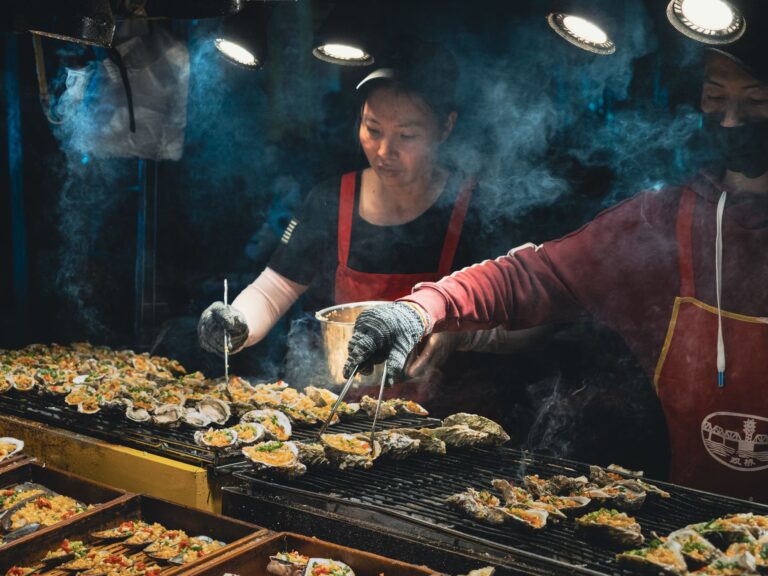
Street vendors succeed where home cooks fail because they understand fire. They use charcoal burned down to steady heat—hot enough that you can only hold your hand 3 inches above for 3-4 seconds. Place the salt-crusted fish directly on the grate and leave it. Flip carefully after 20-25 minutes. Total cook time: 40-45 minutes for a 1.2kg fish. Done right, the crust turns golden with slight cracks. The fish keeps cooking from residual heat even off the fire. Crack it open at the table, peel away the skin (it comes off easily), and serve with dipping sauce, jasmine rice, and fresh veggies like cucumber and cabbage.
Good pla pao takes patience and fire management. But once you grasp why each step matters—the salt’s purpose, the sauce balance, the heat timing—you’re not just cooking. You’re continuing a tradition Bangkok street vendors perfected generations ago. Use fresh fish, taste constantly, and let the process work.